Risk Education
The Dorian Gray Effect: What a Facelift Really Hides
A lifted face looks taut — yet beneath the surface the decline continues. Why aesthetics are not anti-aging and true rejuvenation comes from within.
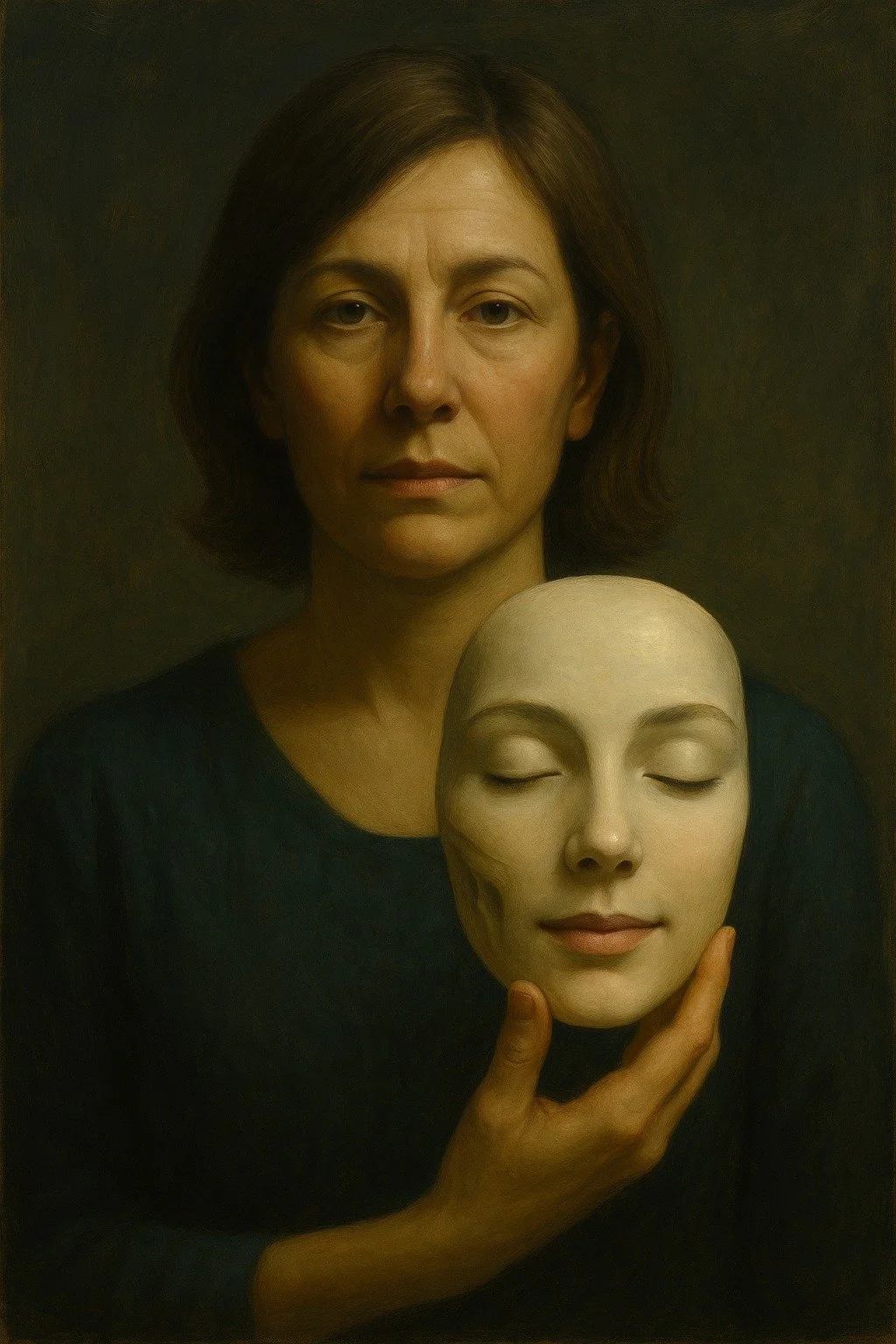
A facelift tightens the skin, but it does not stop the aging process. Beneath the smooth surface, bone, muscle, and tissue keep declining. Anyone who confuses aesthetics with anti-aging will sooner or later be disappointed. True rejuvenation comes from within: from strength in the muscles and bone structure.
When I look at a lifted face — whether well done or less so — I often think of Oscar Wilde's novel The Picture of Dorian Gray.
I read it for the first time at fourteen and was immediately fascinated. Back then I had no idea that one day I would practise a profession that did not yet exist in this form: helping people keep their faces naturally young, alive, and ageless — without surgery, without masking.
Compared with other anti-aging approaches, the FACE Method® works on a different, deeper level: targeted training sets mechanical stimuli that counter the age-related breakdown of muscle and bone structure.
Back to Dorian Gray: the story tells of a young man who falls in love with his own portrait. While the picture ages over the years and reveals every moral lapse, Dorian himself stays flawlessly young and beautiful. But the price is high. With each passing year he drifts further from his true nature — and the ending is tragic.
This story keeps coming to mind when I see faces today that have been surgically rejuvenated. At first glance they often look smooth, full, and youthful — especially in the first weeks after the procedure. But that impression is usually only superficial.
Because surgically tightened faces age too — only this process stays hidden at first. The face looks taut and smoothed, but beneath the surface the decline continues: bones lose volume, muscles lose strength, and the nerves that control our expression are often impaired in their function. The smooth exterior lasts only for a time — and often looks smooth and flawless only from a distance.
What Really Lies Behind a Facelift
A surgical facelift can deliver striking results at first glance. The before-and-after pictures we see online — especially in YouTube videos — often show faces that look clearly younger, firmer, and fresher. Some appear rejuvenated by 15 or even 20 years.
But the impression is deceptive: yes, excess skin was removed, and the face looks full — but this freshness comes primarily from the post-operative swelling. It gives the face short-term volume, which makes it appear fuller and therefore younger.
What many people do not know: these impressive results usually show only the state a few weeks or months after the procedure. When the swelling subsides — which it inevitably does — the picture changes. The face slowly loses tension again, because the natural decline continues. It no longer looks as young as it did right after surgery.
On top of that: even after a facelift, biological aging keeps advancing. Skin, muscle, and bone break down continuously — completely independent of whether the face was tightened or not.
How clearly the bony framework changes has been shown by surgeons using CT scans of 120 faces: with age, the eye sockets become measurably larger, the lower jaw loses height and length, and the angles of the midface flatten (Shaw et al. 2011).
How long the rejuvenated look lasts, and whether you feel comfortable with it over the long term, is highly individual. The fact remains, however: every deep procedure carries risks — and the aging process does not stop, even for a surgically tightened face.
What Happens 2–3 Years After a Facelift?
Once the initial swelling has gone down, the natural aging process resumes unhindered. Bones lose substance, muscles grow weaker, fat deposits shrink — exactly as in a face that has not been operated on. On top of that, scar tissue can form beneath the skin, altering expression or hardening the skin's texture.
Some women report that after a while their face feels unnatural — and at the same time surprisingly slack. On the outside it often still looks firmer than before the lifting, but the feeling of resilience is missing. Many speak of a "loss of the effect" or of the face feeling "foreign." They barely sense any muscle tone — and have the feeling that the operation has reduced it.
What Many Do Not Know: Training After a Facelift Is Often Only Partly Possible
From my experience I know this: women who have had a facelift can train with my method only if the nerve pathways were not damaged and the facial muscles can still be activated.
Because the impulses for every muscle action come from the nerve — and run along clearly defined pathways, especially through the middle of the face.
If these were shifted, irritated, or damaged by the operation, the connection between brain and muscle can be partly disrupted. Training individual muscle groups is then only partly possible, or not possible at all.
Even with successful procedures, it shows clearly: muscle strength is reduced, the tissue responds more sluggishly, and building it up takes more time. The face often has to laboriously "relearn" how to move naturally and with life.
My Recommendation: Stay Young from Within
A facelift can give a short-term feeling of rejuvenation — but it is no substitute for functioning muscle, a stable bone structure, or healthy nerve conduction.
True rejuvenation does not come from tension at the surface, but from strength on the inside.
With targeted training, as I have taught it through the FACE Method® for 30 years, the youthful form of the face can be preserved — or regained piece by piece. Entirely without cuts. Entirely without a mask.
A radiant face does not begin with the surgeon — but with you.
A Final Thought
Aesthetic surgery is a wonderful tool and has helped many people to a better sense of self-worth. Thank goodness it exists. Even a disfigured jaw can be corrected through surgical measures — but that is an entirely different matter.
Whether it is a nose that is too large, strongly pronounced hooded eyelids, protruding ears, or a striking asymmetry — targeted procedures can harmonise the appearance and strengthen one's inner sense of well-being. Even small corrections that make the face look more balanced can have a great effect — on self-image, on charisma, on life.
What is important, however, is to distinguish: aesthetic procedures have to do with form and harmony — not with the aging process. They change contours, but they do not prevent bones from receding, muscles from slackening, or nerve impulses from weakening.
This is exactly what is often not kept apart. Many people hope that a facelift can stop time — yet a lifting is not a biological stop button, but an aesthetic measure. Anyone who confuses aesthetics with anti-aging will, sooner or later, be disappointed.
Biological decline can be actively worked against — the FACE Method® works from within. It continuously builds muscle and bone structure, brings the natural tension back into the face, and shapes it. Regular training with the FACE Method® keeps the face strong, healthy, and expressive — over the years, as long as you keep at it.
Your Christine
Last updated: 11 August 2026