Grundlagen & Methode
Sagging Cheeks After 40: The Cause Lies Beneath the Skin
Why your cheeks start to sag after 40 even when you take good care of your skin, and which layer underneath you can build up yourself at any age.
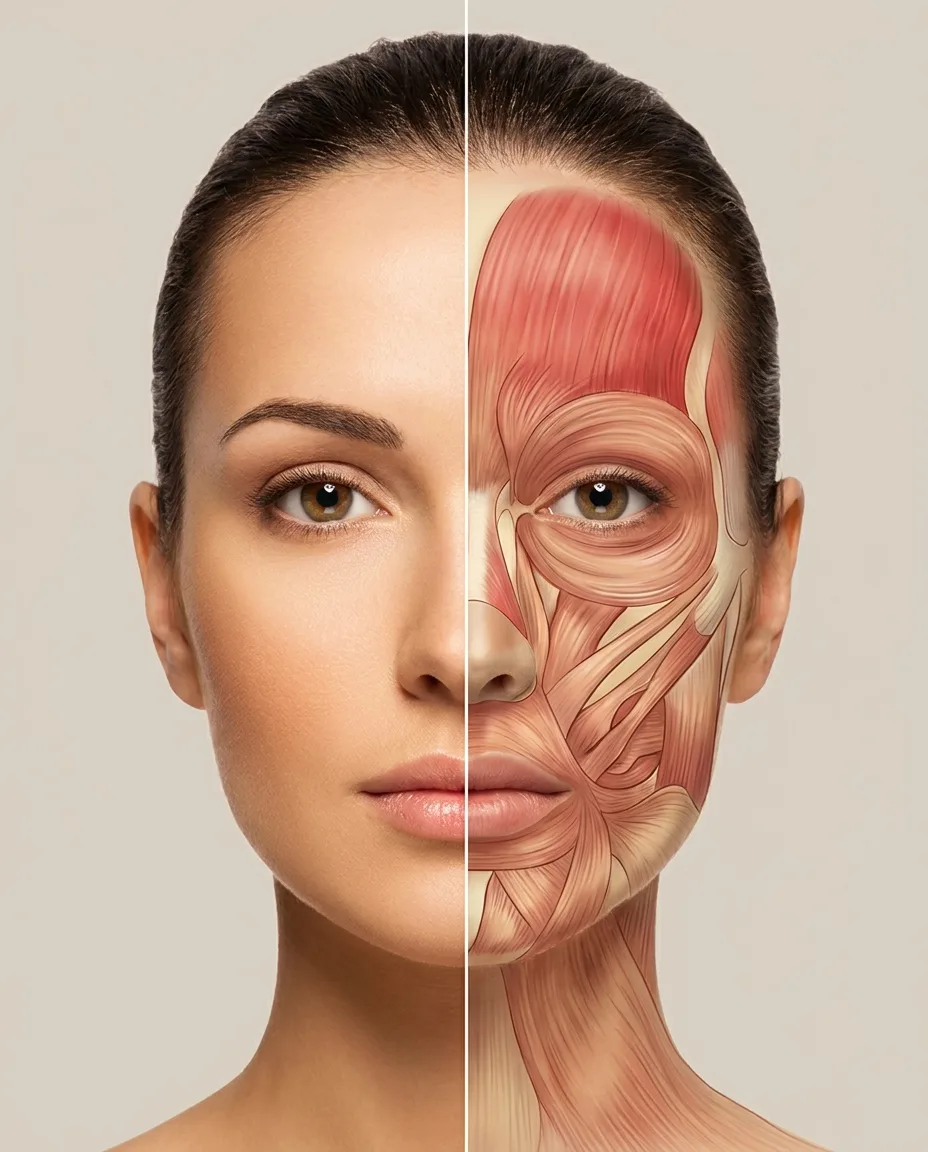
There's a gesture I see again and again in my conversations. A woman places two fingers against her cheeks and gently pushes them upward, back to where they used to sit. For a moment, the line from ear to chin is clear again. Then she lets go. If you've done this yourself in front of the mirror, you know how brief that moment is.
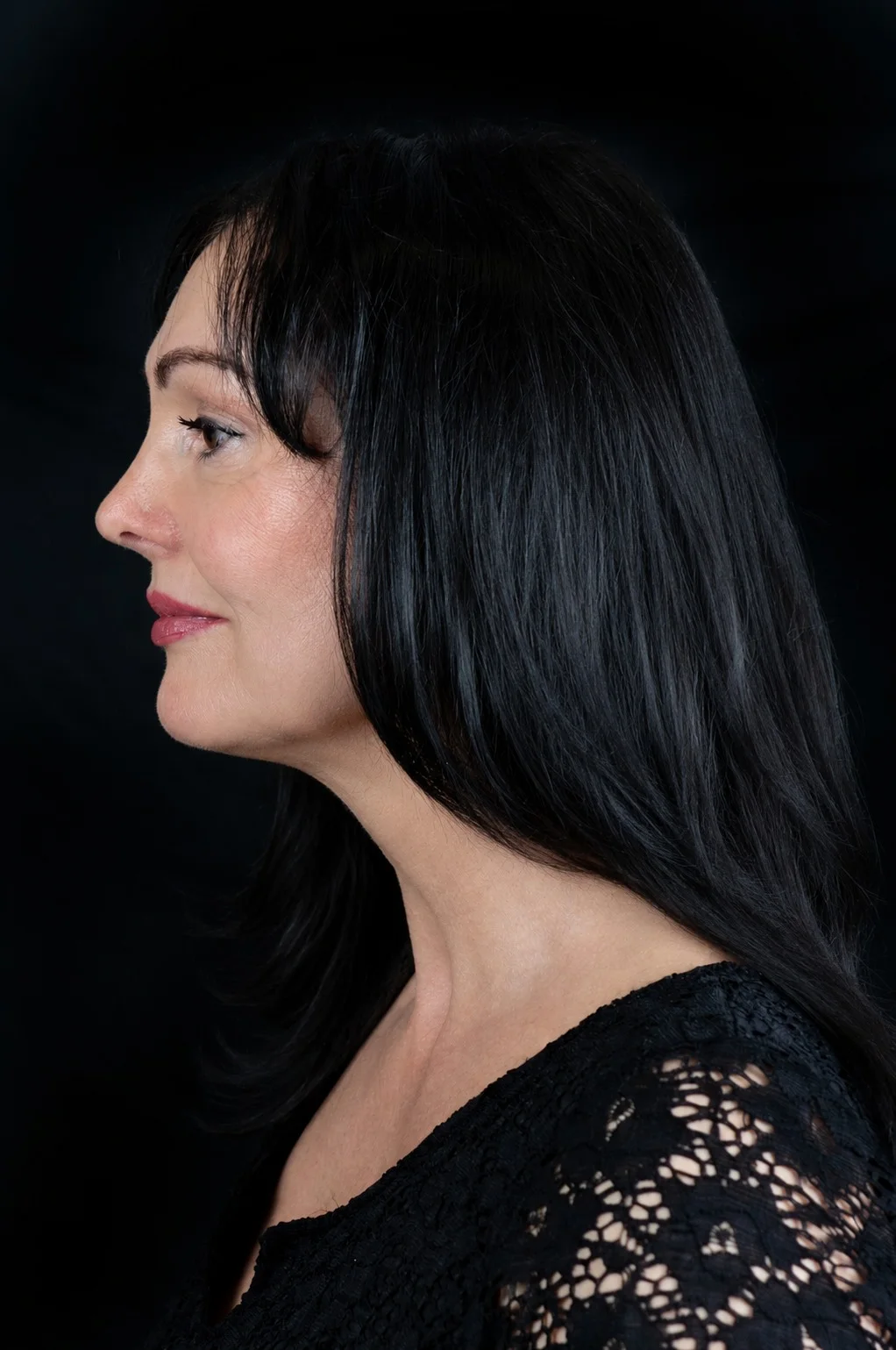
Christine Scheib in profile: the line from ear to chin.
I've worked with women who had already tried good creams and expensive devices. Neither made much difference to their contour. I blend my own creams and know what good skincare can do. It protects the skin barrier and keeps the skin supple, but it doesn't reach the muscle layer. I have little time for devices that promise to do the work for you, because training, to me, means activating your own muscle. So why does the cheek sag so noticeably from 40 onwards, even when you take good care of yourself?
The answer lies in the layers beneath your skin. Four of them support your contour, and all four change over time. One of them you can rebuild yourself, namely your muscle tissue. That layer has been the focus of my work for nearly 30 years.
AT A GLANCE. Sagging cheeks develop across five layers: the skin and the four beneath it. The facial bones lose volume, the cheek fat descends and pools against the retaining ligaments, the muscles lose mass and tone. After menopause, the skin loses collagen year by year. Skincare reaches only the outermost layer. Muscle is the layer that responds to targeted training at any age.
What gives way beneath your skin
I like to explain this with a tent. The skin is the canvas, bones and muscles are the poles. As long as the poles hold, the canvas stays taut. When they give way, even the finest canvas sags, and no amount of waterproofing will stretch it back into shape.

As long as the poles hold, the canvas stays taut. When they give way, it sags.
These layers don't age at the same pace. That's why things seem unchanged for years, and then you suddenly see the difference in the mirror. I'll start with the bone, because that's where it begins.
The bone gets smaller
As solid as it feels, the skull is not a fixed structure. The facial skeleton loses volume with age at very specific sites: the upper jaw and the rim of the nasal opening, parts of the eye socket, and the lower jaw lateral to the chin (Mendelson and Wong 2012).
For your jawline, the mandible matters most. Surgeons measured CT scans from 120 women and men across three age groups. Over time, the jaw angle became less defined while the jaw lost both height and length (Shaw 2010). The bony edge that a sharp jawline depends on genuinely shrinks.
Can training make any difference here? The facial muscles largely originate on bone and radiate into the skin. When they contract with force, they pull on that bone, just as the chewing muscles do with every bite. Bone is living tissue and responds to load. My observations over 30 years show that targeted facial training creates the kind of stimulus that works against this loss. I see contour regaining substance over the months.
Why the cheek slides downward
Above the bone lies the cheek fat, divided into separate compartments with their own boundaries. Surgeons demonstrated this by injecting dye into facial fat in cadaver specimens (Rohrich and Pessa 2007). At the edges of these compartments sit retaining ligaments that anchor skin and soft tissue to the bone at fixed points (Alghoul and Codner 2013).
The jowl forms at exactly one of these boundaries. A ligament along the lower jaw holds the skin in place, while the cheek fat above it descends over the years and accumulates in front of that anchor. Anatomists who examined these ligaments in detail concluded that jowls develop primarily because of descending cheek fat, not because the ligament itself has loosened (Kang 2016).
What supports that fat from below? To a large extent, the muscle beneath it.
Muscle is the layer you can influence
Between the fat and the bone lies the musculature, interwoven with both at many points. The facial muscles also connect into the SMAS, the superficial musculoaponeurotic system, a fascial layer that links the facial muscles into a continuous network. When tension in that network decreases, the entire face loses its support structure.
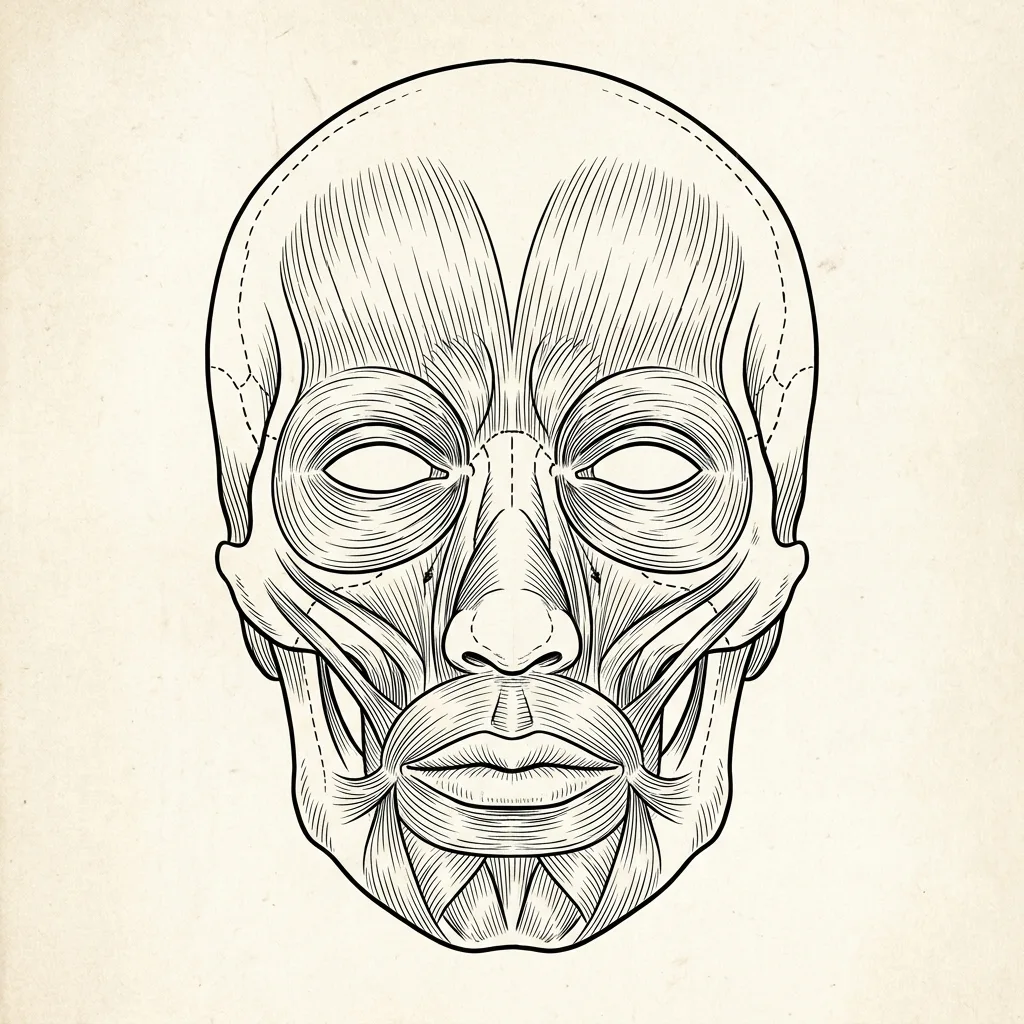
Illustration: the facial muscles of the forehead, eyes, cheeks and mouth.
From the age of 30, the body loses roughly 3 to 8 percent of its muscle mass per decade, and the rate accelerates after 60 (Volpi 2004). That was measured in the body's skeletal muscles. I see no reason why the face should be an exception, because the same principle applies to every muscle. What isn't challenged breaks down. And in everyday life, your facial muscles are rarely challenged, because you speak and smile in the same patterns day after day.
That's why I consider muscle the most underestimated factor when contour begins to give way. And it's also the tent pole you can raise again yourself.
What about hormones?
Around menopause, the skin loses its firmness as well. A study in London measured as far back as 1987 that skin loses roughly one to two percent of its collagen per year after menopause, with bone density at the forearm declining at the same rate (Brincat 1987). Collagen is the protein that gives skin its firmness and elasticity. During these years, both the canvas and the poles give way at the same time, which is why the change becomes visible so quickly.
What can training do about that? It doesn't replace hormones. That's a conversation for your doctor. What load-bearing exercise can achieve was shown by a research group in Australia. 101 postmenopausal women, average age 65 and with low bone density, trained twice a week for eight months under supervision using heavy weights and impact loading. Their lumbar bone density increased by just under three percent, while it continued to decline in the comparison group doing light home exercise (Watson 2018).
That was strength training for the body. What it shows is that bone and muscle respond to load even after menopause. The hormonal shift changes the conditions. What it doesn't take from you is your muscles' capacity to grow stronger.
You are not simply at the mercy of what your face does.
Am I too old to build muscle in my face?
No, you're not, and the most striking evidence comes from a care home in Boston. Ten frail residents with an average age of 90 trained their thigh muscles for eight weeks. Their strength increased by an average of 174 percent, and the muscle cross-section in the thigh grew measurably (Fiatarone 1990). At 90 years old. In eight weeks.
There's also a study specifically for the face. In Chicago, women between 40 and 65 trained their facial muscles at home for 20 weeks, daily at first and then every other day. Two physicians assessed the photographs blind and estimated the women to be on average nearly three years younger at the end than at the start. The cheeks had measurably gained volume both in the upper and lower portions, which the authors attributed to increased cheek muscle mass (Alam 2018). The study was small and had no control group, and the programme was developed by one of the authors. It was even called Happy Face Yoga, but the exercises worked against resistance. What produced results was the resistance, not the name.
I'm 60 and have been training my face for nearly 30 years.
Isn't this just face yoga?
That question reaches me almost every day. Face yoga works with stretches, stroking movements, expressions and relaxation. None of that builds muscle. For that, a muscle needs resistance to work against and a load that increases over time.
The FACE-Methode® is strength training for the face and neck. I work with the same parameters as in strength sports: force, tension, position and precise execution.
A facelift can achieve a great deal, but it doesn't reach the muscle beneath. I've described why its results tend to diminish over the years using the example of Kris Jenner.
Where your training begins
In the face, precision is everything. An exercise that's off by just a few millimetres trains the wrong area. That's why I work through every exercise with you precisely and check your execution before you continue training at home on your own. Which exercises you receive depends on where your face is losing definition, whether that's along the jawline, in the mid-cheek, or somewhere else entirely.

Christine Scheib performing a FACE-Methode® exercise.
How quickly things progress depends, as with any strength training, primarily on how consistently you train. The change is noticeable and becomes visible. Always.
The next time you place two fingers against your cheeks and push them upward, you'll know what's missing underneath. And you'll know that's exactly what can be trained.
It starts with a personal initial consultation. We look at your face together, and I show you where training would make a difference for you specifically. The consultation is free of charge and takes place via Zoom. After that, you decide whether and how you'd like to continue.
I look forward to hearing from you.
Christine
FAQ
At what age do cheeks start to sag? The breakdown begins long before you can see it. Muscle mass in the body starts declining from around age 30 (Volpi 2004). Starting training early keeps the poles stable before they begin to give way.
Can you train away jowls? The fat that accumulates in front of the ligament along the lower jaw won't disappear through training. What you can build is the muscle that supports the cheek and jawline from within. My observation over 30 years is that the cheek area lifts visibly as a result, and the jawline becomes defined again.
Does training still help after menopause? Yes. Menopause affects the skin and bones, but both continue to respond to load. In postmenopausal women, bone density increased under supervised strength training (Watson 2018).
Is the FACE-Methode® the same as face yoga? No. Face yoga works with stretching, facial expressions and relaxation. The FACE-Methode® is strength training for the muscles of the face and neck, with targeted load and precise execution.
How soon will I see a change? That depends on your starting point, how consistently you train, and the precision of your execution. For some, the change shows up early. For others, the build-up takes a little more time.
References
- Mendelson B, Wong CH. Changes in the facial skeleton with aging: implications and clinical applications in facial rejuvenation. Aesthetic Plast Surg. 2012;36(4):753–60. PubMed 22580543
- Shaw RB Jr, Katzel EB, Koltz PF, Kahn DM, Girotto JA, Langstein HN. Aging of the mandible and its aesthetic implications. Plast Reconstr Surg. 2010;125(1):332–342. PubMed 20048624
- Rohrich RJ, Pessa JE. The fat compartments of the face: anatomy and clinical implications for cosmetic surgery. Plast Reconstr Surg. 2007;119(7):2219–2227. PubMed 17519724
- Alghoul M, Codner MA. Retaining ligaments of the face: review of anatomy and clinical applications. Aesthet Surg J. 2013;33(6):769–82. PubMed 23855010
- Kang MS, Kang HG, Nam YS, Kim IB. Detailed anatomy of the retaining ligaments of the mandible for facial rejuvenation. J Craniomaxillofac Surg. 2016;44(9):1126–30. PubMed 27427339
- Volpi E, Nazemi R, Fujita S. Muscle tissue changes with aging. Curr Opin Clin Nutr Metab Care. 2004;7(4):405–10. PubMed 15192443
- Brincat M, Kabalan S, Studd JW, Moniz CF, de Trafford J, Montgomery J. A study of the decrease of skin collagen content, skin thickness, and bone mass in the postmenopausal woman. Obstet Gynecol. 1987;70(6):840–5. PubMed 3120067
- Watson SL, Weeks BK, Weis LJ, Harding AT, Horan SA, Beck BR. High-Intensity Resistance and Impact Training Improves Bone Mineral Density and Physical Function in Postmenopausal Women With Osteopenia and Osteoporosis: The LIFTMOR Randomized Controlled Trial. J Bone Miner Res. 2018;33(2):211–220. PubMed 28975661
- Fiatarone MA, Marks EC, Ryan ND, Meredith CN, Lipsitz LA, Evans WJ. High-intensity strength training in nonagenarians. Effects on skeletal muscle. JAMA. 1990;263(22):3029–34. PubMed 2342214
- Alam M, Walter AJ, Geisler A, Roongpisuthipong W, Sikorski G, Tung R, et al. Association of Facial Exercise With the Appearance of Aging. JAMA Dermatol. 2018;154(3):365–367. PubMed 29299598
Last updated: 18 November 2026