Praxis
Becoming a FACE Trainer: What You Learn and How Long It Takes
What you learn in the training to become a certified FACE Trainer with me, how long it takes, and how you get started. By Christine Scheib.
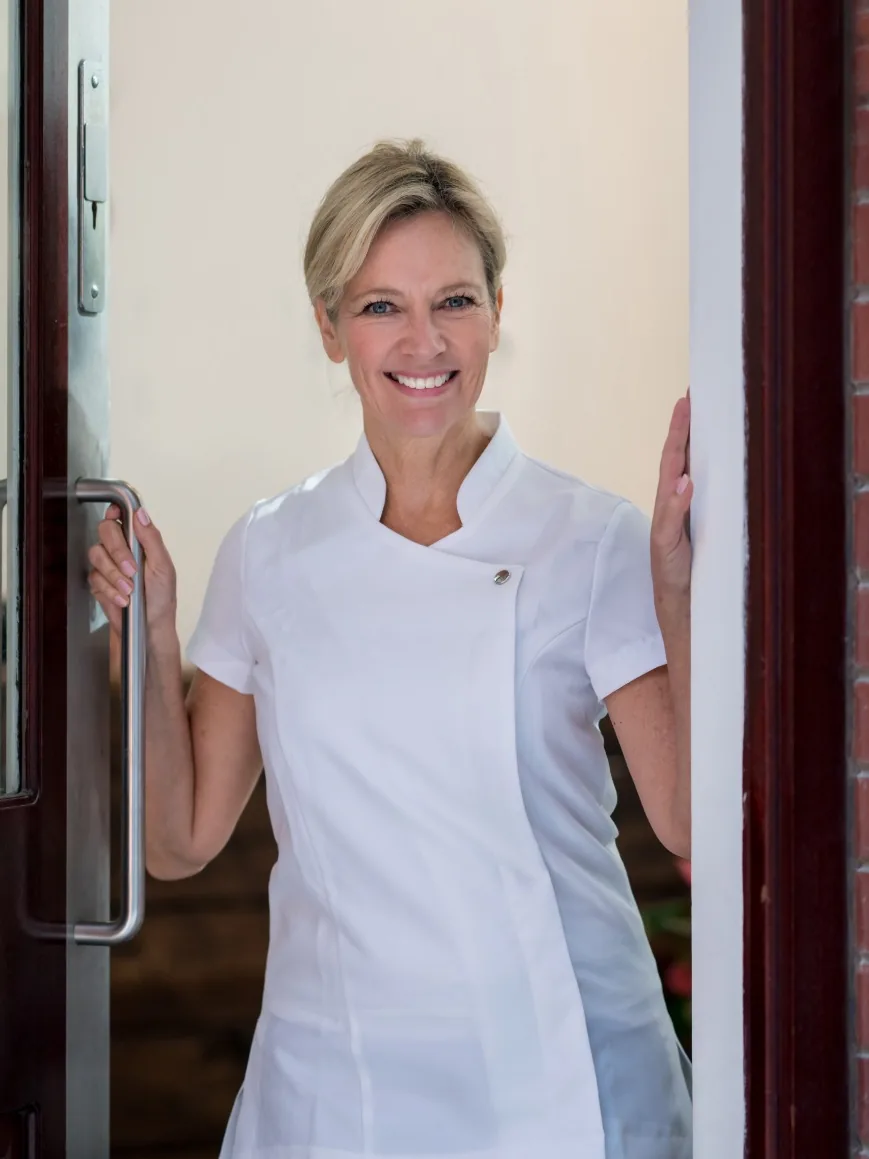
Maybe you've been running a beauty studio or practice for years, with clients who trust you. And maybe you're still wondering what you'll have to offer them in a few years, when the next studio opens nearby with a new device and a launch discount. You could buy another device too, but then you'd have something anyone else can buy as well.

Another device is something anyone can buy.
My training programme page covers what you'll learn and what it costs. Before you get in touch, though, you'll probably want to know more. What kind of training is this, how does it fit around your existing business, and will you be on your own once it's done?
AT A GLANCE. The certified FACE Trainer programme takes place personally with me, one-on-one, over roughly a year. You'll learn the anatomy of the face and neck, facial analysis, the precise execution and teaching of the exercises, and how to build individual training plans. The fee is listed on my training programme page, and payment in instalments can be arranged. After you qualify, I remain your professional point of contact. It all starts with a personal initial consultation.
What you'll learn
The FACE-Methode® is strength training for the face and neck. I work with the same parameters as in strength sports, namely force, tension, position and precise execution. Anyone who wants to guide others through this needs far more than a set of exercises.
You start by learning how the musculature of the face and neck is structured, how the individual areas work together, and how they interact with the bony framework of the face. How else would you explain to a client why her jawline is losing definition, or decide where her training should begin?
Then come the exercises themselves. You learn to perform them with precision and to explain them clearly, to recognise the errors that creep in with a client, and to guide her through her training step by step. Precision matters here, because an exercise that sits even a few millimetres off trains the wrong area.
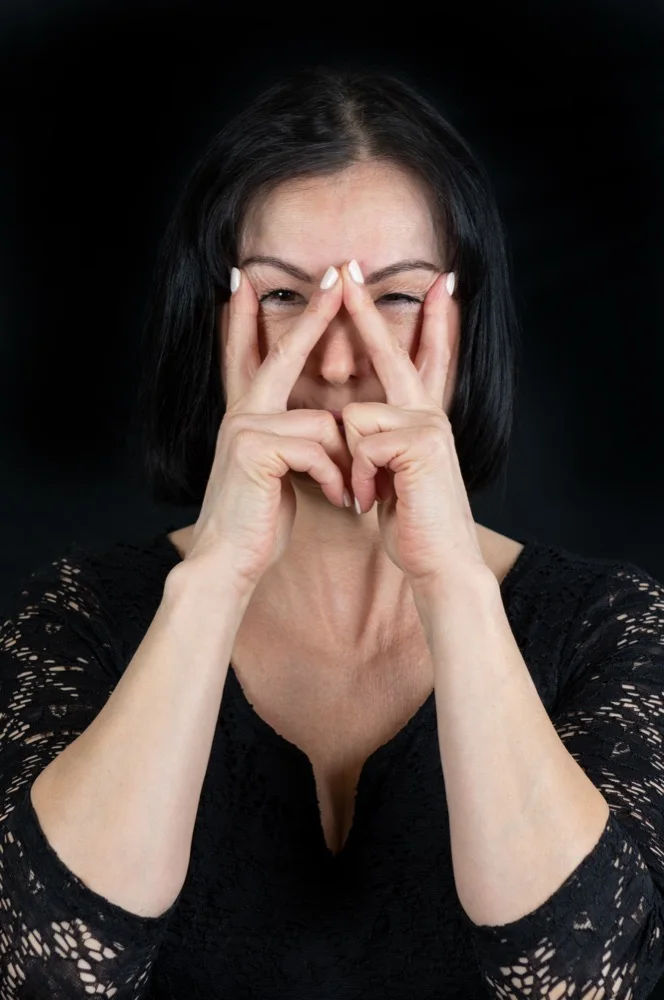
Christine Scheib performing a FACE-Methode® exercise. Where the fingers are placed determines which area does the work.
The third part is analysis. Every face ages differently. In one client the jawline gives way, in another it's the cheeks or the eye area. You assess proportions, asymmetries and the condition of the musculature, and from that you determine where the priorities lie. The analysis leads to the training plan, where you put together exercises, sequence, intensity and progression in a way that fits this one face and this client's goal. There is no one-size-fits-all programme here.
Why you don't need a device for this
The method works with your client's own muscle strength, without devices and without interventions. I myself monitor the engagement of the facial muscles with my hands, especially in the early stages.
A client may ask whether this is just face yoga. I get that question almost every day. Face yoga works with gentle movements, stretches and strokes that act on the surface of skin and tissue, and it lacks the resistance needed to build muscle. You wouldn't expect a bicep to grow with miniature weights either. The American College of Sports Medicine states in its guidelines that a muscle only continues to adapt when the resistance in training increases alongside it (American College of Sports Medicine 2009).

A muscle only grows against a resistance that challenges it.
And if a client wants to know whether she's too old for muscle development? You can tell her about a study published in 1990 by a research group in Boston. Ten frail nursing home residents around the age of 90 trained for eight weeks with high resistance, and among the nine who completed the programme, strength increased by an average of 174 percent while the cross-sectional area of the thigh muscle grew by 9 percent (Fiatarone 1990). At 90 years old, in eight weeks.
Four years later, the same lead author repeated this with 100 nursing home residents averaging 87 years of age. Half were randomly assigned to ten weeks of progressive resistance training; the other half were not. In those who trained, muscle strength more than doubled by the end. In the others, it remained almost unchanged (Fiatarone 1994).
Neither study examined the face. The facial musculature follows the same principles as every other muscle in the body. My observations over 30 years show that it responds to training stimulus, gains strength and visibly develops. That is what you explain to your clients after qualifying, and what you work through with them.
How long the training takes
I train every practitioner personally, one-on-one, combining theory and practice. The process takes roughly a year. I pace it according to your progress, and you get as much time as your learning requires.
You don't have to wait until the final day to start working with clients. Depending on how your training is progressing, you can begin accompanying clients under my guidance during the programme.
How this year fits around your existing business is something only your calendar can answer. Bring that question to our conversation, along with your opening hours and the time you can realistically set aside each week.
What the training costs
The programme fee covers your complete training as a certified FACE Trainer. The amount is listed on my training programme page, and payment in instalments can be arranged.
Does it make financial sense for you? I can't work that out from here, because I don't know your pricing, your capacity or your client base. You're paying for a year in which I train you personally, and what you offer afterwards is your own expertise. How many clients you attract with it depends on you and your location, and any figure I gave you would be a guess.
That's why it starts with a personal initial consultation. It's free of charge and takes place via Zoom. Let me know at the start that you're interested in the training programme, and we'll talk through it and your questions. You decide afterwards.
What the training asks of you
My locations page lists the trainers and studios I have trained, across Switzerland, Germany and Austria. Take a look through it. Most of these studios have beauty or aesthetics in their name.
What the training asks of you is visible in its content. You work through the anatomy, you learn every exercise to the level of precision where you can teach it and spot a client's errors, and you plan fresh for every face. If you're looking for a ready-made programme to hand to every client, you won't find it here.
How quickly a face changes depends, as with any strength training, on how consistently and how precisely the work is done. The change is felt and becomes visible. Always.
What comes after you qualify
By the end of your training, you are the FACE Trainer I would trust with my own clients.
My support doesn't end with your qualification. I remain your professional point of contact, and we work through unusual situations together so you can find a safe and appropriate approach for every client.
If, after reading this, you'd like to find out whether this path fits you and your business, let's talk. It starts with a personal initial consultation, free of charge and via Zoom. If you'd prefer to write first, there's a form on the services page, and I'll get back to you personally. You decide afterwards whether and how you'd like to proceed.
Looking forward to hearing from you.
Christine
FAQ
How long does the FACE Trainer training take? Roughly a year. I train you personally, one-on-one, and pace the programme according to your progress. Depending on how your training is going, you can begin accompanying clients under my guidance during the programme.
What does the training cost? The programme fee covers the complete training as a certified FACE Trainer. The amount is listed on my training programme page, and payment in instalments can be arranged.
What will I learn? The anatomy of the face and neck, facial analysis, the precise execution and teaching of the exercises, and how to build individual training plans including sequence, intensity and progression.
Do I need to be a beautician to become a FACE Trainer? Whether your background is a good fit is something we discuss in the initial consultation. If you want to become a FACE Trainer, get in touch with me directly.
Is the FACE-Methode® the same as face yoga? No. Face yoga works with gentle movements, stretches and strokes at the surface. My method is targeted muscle-building training using force, tension, position and precise execution.
Will I be on my own after I qualify? No. I remain your professional point of contact, and we work through unusual situations together.
References
- American College of Sports Medicine. American College of Sports Medicine position stand. Progression models in resistance training for healthy adults. Med Sci Sports Exerc. 2009;41(3):687–708. PubMed 19204579
- Fiatarone MA, Marks EC, Ryan ND, Meredith CN, Lipsitz LA, Evans WJ. High-intensity strength training in nonagenarians. Effects on skeletal muscle. JAMA. 1990;263(22):3029–34. PubMed 2342214
- Fiatarone MA, O'Neill EF, Ryan ND, Clements KM, Solares GR, Nelson ME, et al. Exercise training and nutritional supplementation for physical frailty in very elderly people. N Engl J Med. 1994;330(25):1769–75. PubMed 8190152
Last updated: 18 November 2026