Grundlagen & Methode
Double Chin: Why It Stays Soft Under the Chin
You take care of your neck, and yet it stays soft under the chin? That's where the floor of the mouth is, a muscle no cream can reach and one you can train.
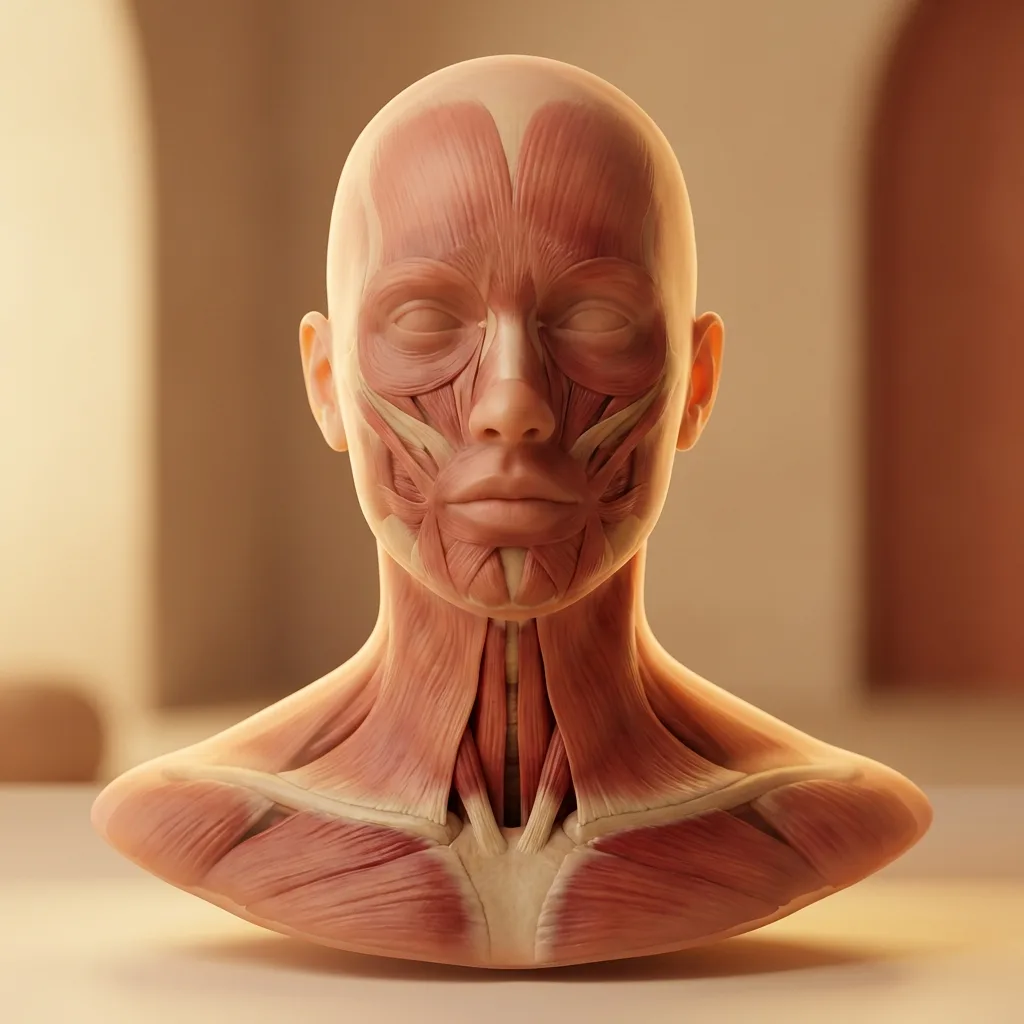
From the front, you might be perfectly happy with your face. Then someone shows you a photo taken from the side, and there it is: your chin flows into your neck with barely a defined angle. And you're already doing something about it. You moisturise your neck every evening, you massage it, and in front of the camera you push your chin forward slightly. So why does the area under your chin stay soft?
I look at every face in profile too, because that's where you can see where the structure has given way. Under the chin lies an area that tends to get overlooked, because it doesn't visibly do anything. It's the floor of the mouth, a layer of muscle between the lower jaw and the neck. Neither your moisturiser nor massage nor good posture builds it up. It can still be trained, though, because it's a muscle, and muscles respond to training.
AT A GLANCE. Under the chin, from the outside in, lie the skin, fat, the thin neck muscle called the platysma, and deepest of all, the floor of the mouth. It stretches like a hammock from the lower jaw to the hyoid bone, and everything else hangs beneath it. In older people, one of the muscles of the floor of the mouth is on average thinner, and the hyoid bone sits further from the jaw. A moisturiser cares for the skin and massage moves the tissue, but neither builds muscle. The floor of the mouth responds to training, and it only comes into play once the neck and jawline are stable.
What's actually under your chin?
Beneath your skin there is first a layer of fat, and then the platysma. This is a thin, flat muscle that begins in the subcutaneous tissue over the chest and shoulders and runs up across the entire neck into the lower face. It belongs to the muscles of facial expression and is connected to the skin across its entire surface (Minelli 2023). Directly under the chin, it is often not even continuous. In 50 cadaver specimens, the fibres from both sides intertwined only one to two centimetres below the chin in three out of four cases, running separately everywhere else (de Castro 1980). For me, such a thin skin muscle is not a support structure for this area.
Below the platysma lies another layer of fat (Larson 2014). This deep fat borders on the inside against the floor of the mouth (Rohrich and Pessa 2010). The floor of the mouth is the innermost layer, because behind it the oral cavity begins.
The floor of the mouth is a hammock of muscles
The largest part of the floor of the mouth is a muscle called the mylohyoid. It is flat and triangular, originates on the inside of the lower jaw at the level of the molars, and attaches to the hyoid bone. Anatomists describe it as a hammock that can contract and supports the base of the oral cavity (Toth and Lappin 2023). Together with three further pairs of muscles, it lies between the lower jaw and the hyoid bone. You use these muscles every time you swallow, chew, and speak (Khan 2025). Seen from the outside, everything else hangs beneath this hammock: the deep fat, the platysma, the superficial fat, and the skin.
The hyoid bone is a small, horseshoe-shaped bone at the front of the neck, below the lower jaw. It is not connected to any other bone (Garg 2025). It is held in place primarily by the muscles that attach to it from above and below. At its level lies the angle between chin and neck, where the platysma also changes direction (Minelli 2023). Where the hyoid bone sits therefore also depends on the tension in these muscles.

When the hammock is taut, the line beneath it stays flat. When it sags, everything below follows.
What changes over the years?
A research group in North Carolina compared the CT scans of 40 healthy older adults, average age 78, with those of 40 younger people. One muscle of the floor of the mouth, running from the chin to the hyoid bone, had a smaller cross-section in the older group. There was also more fat deposited within it (Feng 2013). In a second analysis, again with 40 older and 40 younger participants, the same researchers measured the distance between the lower jaw and the hyoid bone. In the older group, the hyoid bone sat further from the jaw in both measured directions (Feng 2014).
The researchers were interested in safe swallowing. They compared older people with younger ones rather than following anyone over time. What does this mean for your profile? For me, their measurements explain what you see in the photo. When the hammock loses substance and sags, the hyoid bone sits further from the jaw. The angle between chin and neck becomes shallower. Everything hanging beneath the floor of the mouth drops with it.
The platysma changes too. According to a more recent anatomical study, the connective tissue in which the muscle is embedded loosens with age. Under its resting tension, this is likely what produces the vertical bands you recognise from an older neck (Minelli 2023).
Why doesn't moisturiser reach that far?
I mix my own creams and I think a great deal of good skincare. It protects the skin barrier, preserves moisture, and keeps the skin on the neck supple. What holds the line between chin and neck, however, lies deeper: beneath the skin, two layers of fat, and the platysma. And even if an active ingredient could penetrate that far, it would not build muscle there, because muscle only develops when it is challenged. No moisturiser reaches that point.

Good skincare has real value. It doesn't reach the muscle under the chin.
What does massage actually do?
Massage moves the skin and the tissue directly beneath it back and forth, whether you use your hands, a roller, or a stone tool. The muscle in the deeper layers is not challenged by this. Nobody would think of building up an arm muscle by stroking it. Only resistance, something to work against, prompts a muscle to grow stronger. Why would it be any different under the chin?
What if you simply hold your head straighter?
Posture does play a role. A research group in Tokyo examined 87 healthy women and men aged 65 and over. Those who carried their head in a forward position had a muscle between the chin and hyoid bone that was on average longer. The researchers interpret this as overstretching and see it as the link between a forward head position and reduced strength in these muscles (Tamai 2022).
An upright head position likely keeps these muscles less overstretched. That does not make it a training stimulus, because posture alone does not place the muscle under the kind of tension it needs to develop. And pushing the chin forward only tightens the area for the single moment the photo is taken.
Can the floor of the mouth actually be built up?
Yes, and this has been measured. For a study at the Netherlands Cancer Institute in Amsterdam, ten healthy older volunteers trained the muscles above the hyoid bone against resistance every day for six weeks. Afterwards, they were measurably stronger there. The volume of these muscles had also increased (Kraaijenga 2015). In South Korea, people who had difficulty swallowing after a stroke trained alongside their usual therapy for six weeks as well. In the 21 who completed the programme, the floor-of-mouth muscle and a second muscle under the chin were measurably thicker on ultrasound than before (Choi 2020).
Both studies were small and had no comparison group that did not train at all. The programmes came from swallowing therapy, and improving facial contour was not the goal. They do show, however, that these muscles respond to resistance the way every other muscle in your body does, including in older people.
Why the floor of the mouth never comes first with me
In the FACE-Methode®, the floor of the mouth has its established place, but it never comes first. I start by building stability in the neck with you, then the jawline. Only once that foundation holds does the work under the chin follow. The floor of the mouth is engaged from the inside, with small, precise movements, so that almost nothing is visible from the outside and the neck stays still. The moment the neck visibly joins in, the tension is distributed incorrectly. It takes over a task that isn't its own, and nothing changes under the chin.
Precision is what decides the outcome here, because an exercise that is off by just a few millimetres trains the wrong area. That is why I work through every exercise with you personally and check your execution before you continue training at home on your own.
My observations over 30 years show that this work builds up the contour under the chin and restores a clear separation between chin and neck in profile.

In profile, you can see whether the area under the chin has real support.
Does your training start at the neck, the jawline, or already at the floor of the mouth? I can see that when I have your face and your profile in front of me. It starts with a personal initial consultation, free of charge and via Zoom.
Isn't a double chin simply fat?
Partly, yes. The fat that lies in two layers under your skin is not something you train away. The structure of your profile plays a role too: if the distance between chin and neck is naturally small, a double chin shows earlier. What you can build up is the muscle that supports this area from the inside. The floor of the mouth stabilises the transition between jaw and neck. When it is strong, the area under your chin has internal support.
It is not too late for that even in your late fifties, because muscle responds to training at any age. I am 60 and have been training my face for almost three decades. The neck is always part of it. How quickly you see results depends, as with any muscle training, on how consistently and how precisely you train. The change is felt and becomes visible. Always.
Your moisturiser can stay on the bathroom shelf, because it looks after your skin. The line between chin and neck is the job of the muscle beneath it, and that muscle you can train.
It starts with a personal initial consultation. We look at your face and your profile together. I show you where training would begin for you specifically. The consultation is free of charge and takes place via Zoom. After that, you decide whether and how you want to continue.
Feel free to book a time that suits you. I look forward to meeting you.
Christine
FAQ
What is the floor of the mouth? The floor of the mouth is the layer of muscle beneath the tongue that forms the base of the oral cavity. Its largest muscle stretches like a hammock from the lower jaw to the hyoid bone (Toth and Lappin 2023). Seen from the outside, it lies behind the chin, covered by skin, fat, and the platysma.
Does moisturiser help with a double chin? A good moisturiser cares for the skin on the neck. The contour under the chin, however, is held by muscle, and no moisturiser builds muscle.
Can you train away a double chin? The fat under the chin is not something you train away. What you can build up is the muscle that supports this area from the inside. In my experience, this builds up the contour under the chin and restores a clear separation between chin and neck.
Which exercises help with a double chin? That depends on your face and your profile. In my work, we start with stability in the neck, then the jawline, and only then the floor of the mouth. Which exercises you receive is something I determine after your personal facial analysis, and I work through each one precisely with you.
What does head posture have to do with a double chin? In older people who carried their head in a forward position, one muscle between the chin and hyoid bone was on average longer, which the researchers interpret as overstretching (Tamai 2022). An upright posture does not build this muscle up, though. For that, it needs a training stimulus.
Can the floor of the mouth still be built up at 60? Yes. In a small study, healthy older volunteers measurably strengthened the muscles above the hyoid bone through resistance training and increased their volume (Kraaijenga 2015). Muscle responds to training at any age.
References
- Minelli L, Wilson JL, Bravo FG, Hodgkinson DJ, O'Daniel TG, van der Lei B, et al. The Functional Anatomy and Innervation of the Platysma is Segmental: Implications for Lower Lip Dysfunction, Recurrent Platysmal Bands, and Surgical Rejuvenation. Aesthet Surg J. 2023;43(10):1091–1105. PubMed 37186556
- de Castro CC. The anatomy of the platysma muscle. Plast Reconstr Surg. 1980;66(5):680–3. PubMed 7433553
- Larson JD, Tierney WS, Ozturk CN, Zins JE. Defining the fat compartments in the neck: a cadaver study. Aesthet Surg J. 2014;34(4):499–506. PubMed 24633742
- Rohrich RJ, Pessa JE. The subplatysmal supramylohyoid fat. Plast Reconstr Surg. 2010;126(2):589–595. PubMed 20679840
- Toth J, Lappin SL. Anatomy, Head and Neck, Mylohyoid Muscle. 2023. PubMed 31424877
- Khan YS, Fakoya AO, Bordoni B. Anatomy, Head and Neck: Suprahyoid Muscle. 2025. PubMed 31536316
- Garg DR, Fakoya AO, Menezes RG. Anatomy, Head and Neck: Hyoid Bone. 2025. PubMed 30969548
- Feng X, Todd T, Lintzenich CR, Ding J, Carr JJ, Ge Y, et al. Aging-related geniohyoid muscle atrophy is related to aspiration status in healthy older adults. J Gerontol A Biol Sci Med Sci. 2013;68(7):853–60. PubMed 23112114
- Feng X, Todd T, Hu Y, Lintzenich CR, Carr JJ, Browne JD, et al. Age-related changes of hyoid bone position in healthy older adults with aspiration. Laryngoscope. 2014;124(6):E231–6. PubMed 24227680
- Tamai T, Hara K, Nakagawa K, Namiki C, Yamaguchi K, Yoshimi K, et al. Strength and morphology of a suprahyoid muscle and their relationship to forward head posture in healthy older adults. Geriatr Gerontol Int. 2022;22(9):779–784. PubMed 36058622
- Kraaijenga SA, van der Molen L, Stuiver MM, Teertstra HJ, Hilgers FJ, van den Brekel MW. Effects of Strengthening Exercises on Swallowing Musculature and Function in Senior Healthy Subjects: a Prospective Effectiveness and Feasibility Study. Dysphagia. 2015;30(4):392–403. PubMed 25840788
- Choi JB, Jung YJ, Park JS. Comparison of 2 types of therapeutic exercise: jaw opening exercise and head lift exercise for dysphagic stroke: A pilot study. Medicine (Baltimore). 2020;99(38):e22136. PubMed 32957335
Last updated: 18 November 2026