Risiko-Aufklärung
Botox Long-Term Effects: What Happens to the Muscle After Years
Botox keeps the muscle inactive for months. What years of injections do to it, what is myth, and how you can rebuild it.
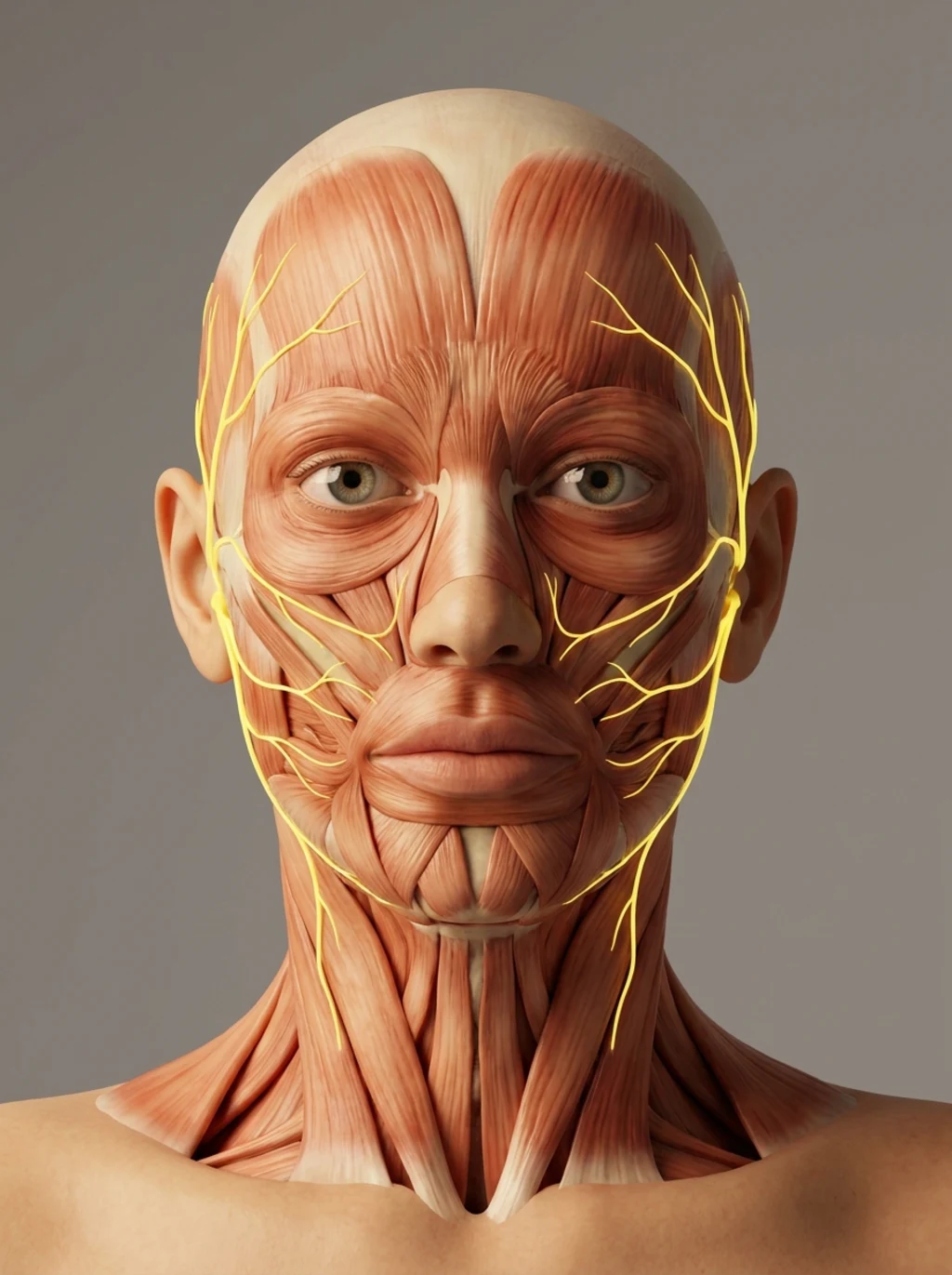
I've worked with women who had already booked a Botox consultation and then cancelled it. They wanted to keep their own face, just fresher. Are you standing at that crossroads right now, or have you been getting injections for years? Either way, you should know what radiologists in Munich measured inside a frown line.
They injected two men with a single dose of 20 units of Botox between the eyebrows and tracked the muscle at the bridge of the nose (the one that pulls on that line) with MRI scans for a full year. After six to ten months, the line had returned. The muscle, however, had shrunk by 46 to 48 percent and stayed that small for twelve months (Koerte 2013).
Two men is a small sample. For me as a FACE trainer, though, this is the most important finding on the subject, because it confirms what holds true for every muscle. A muscle that isn't allowed to work gets smaller, and it stays smaller for longer than you can see from the outside. The line is back long before the muscle is. I'm a trainer, so when I look at Botox, I look at the muscle first and the line second. Everything medical you discuss with your doctor.
AT A GLANCE. Botox immobilises a muscle for a few months. After that, the nerve reconnects and the line returns. Anyone who keeps getting top-ups over the years turns that temporary pause into a long-term state in which the treated muscle gradually shrinks. That shrinkage reverses once the muscle is allowed to work again, and that is exactly where training comes in. Antibodies against Botox are rare. I'm not aware of any evidence for the face suddenly collapsing after stopping treatment.
What Botox does inside the muscle
Botulinum toxin acts at the junction where the nerve meets the muscle. There it blocks the release of acetylcholine, the messenger that tells the muscle to contract. Without that signal, the muscle stays still. The line above it smooths out because nothing is pulling on the skin from below. Botox doesn't change the skin itself. It simply removes the tension underneath it.
The body doesn't simply accept that blockade. The nerve sprouts new, fine branches toward the muscle, and eventually the original connection takes over again, as has been demonstrated in mice (de Paiva 1999). That is why the effect lasts only a few months (Ayoub 2025). Movement returns, and with it the line. Anyone who wants to hold the result has to keep extending that forced rest for the muscle.
As far back as 1990, long before Botox was approved for frown lines, the US National Institutes of Health noted at a consensus conference that the long-term effects of ongoing treatment were unknown (NIH 1990). Approval for frown lines in the United States followed in 2002 (Ayoub 2025). I find that worth noting. Anyone who has been getting injections for years is relying on something whose long-term effects nobody had studied at the time.
At the line itself, Botox delivers what it promises. A twin who had her forehead and frown line treated two to three times a year for 13 years had no deeply etched lines there, while her barely-treated sister did (Binder 2006). My question as a trainer starts one layer deeper, at what happens to the muscle across all those years of repetition.
What years of enforced rest do to the muscle
You know this principle from the rest of your body. An arm that spends six weeks in a cast comes out visibly thinner, and no doctor is surprised by that. Why would the face be any different? A muscle that isn't allowed to work has no reason to maintain its mass, whether it sits in your arm or across your forehead.

An arm that spends six weeks in a cast comes out visibly thinner.
Aesthetic medicine even uses this deliberately. When Botox is injected into the masseter to slim the jawline, the resulting muscle loss is the whole point. Dermatologists in Seoul measured the masseter after injection using ultrasound and 3D imaging. It became thinner and smaller over twelve weeks, more markedly so at higher doses (Hong 2021). What is intentional at the jaw happens incidentally at the forehead.
Plastic surgeons in Cleveland compiled what is known about this shrinkage. It occurs after Botox, deliberately at the jaw and as an unintended side effect at the temple following migraine treatments. They identify repeated immobilisation of the muscle as the cause. Is the shrinkage permanent? No. The same authors note that it is temporary and reverses (Durand 2016).
Anyone who has been having their forehead treated for years has muscles there that are smaller and weaker than before. Those same muscles can be rebuilt once they are allowed to work again. I consider this quiet atrophy the real long-term consequence of Botox. It isn't dangerous, but every woman deserves to know about it before the first injection.
The muscles affected are the treated ones: forehead, frown line, crow's feet. Cheeks, the area around the mouth and the jawline are untouched by standard treatments. When those areas lose definition, the reason lies elsewhere, in the layers beneath the skin.
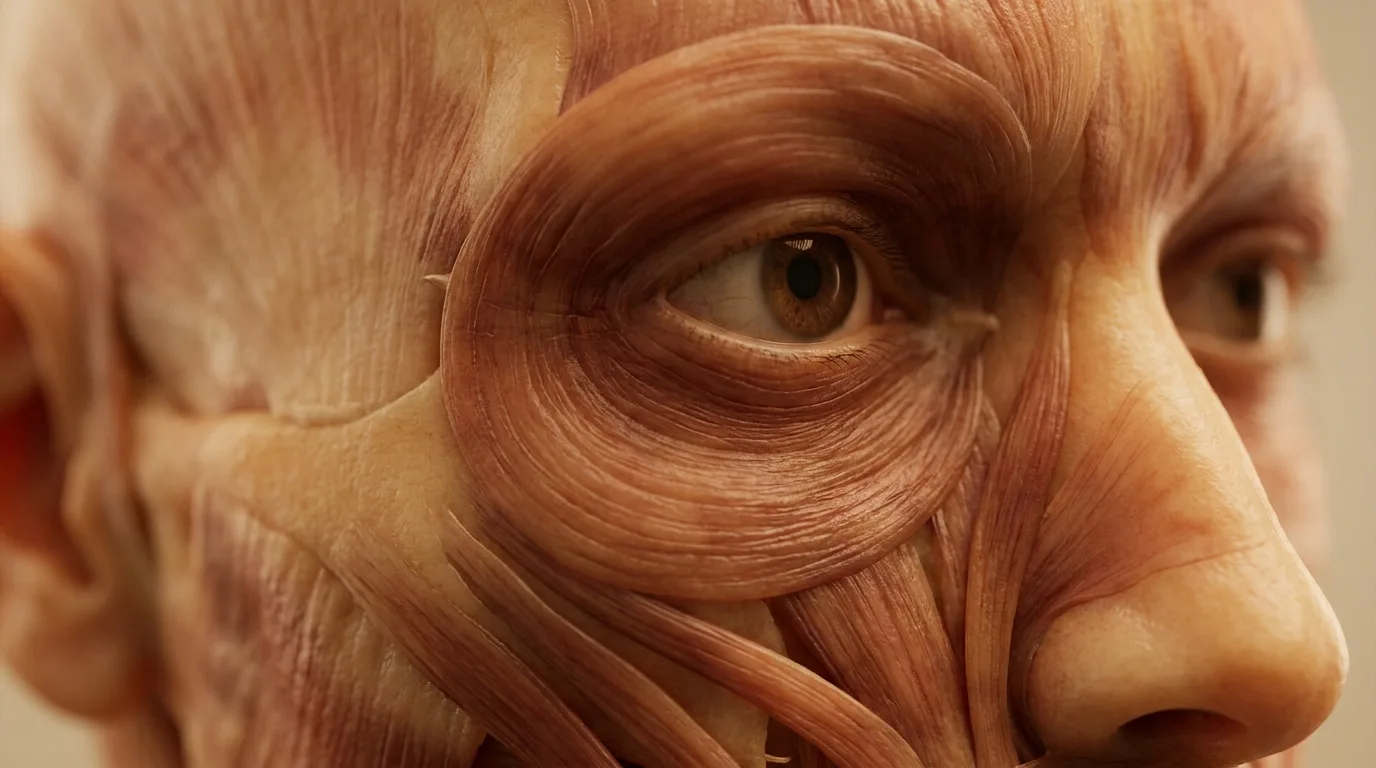
Illustration: the orbicularis oculi. Crow's feet form along this muscle, one of the classic targets of Botox treatment.
When neighbouring muscles step in
The muscles of the face never work in isolation. They are linked in chains, so a change in one place always affects what surrounds it. When one muscle is immobilised, others take on part of its work. At the jaw this has actually been measured. After women had their masseter treated with Botox, volume at the temple increased (the authors' assessment being that the temporalis muscle was compensating by taking on more of the chewing load (Nikolis 2020)).
And what happens to the expression that the immobilised muscle used to produce? Other muscles take it over, and that is how tension patterns develop that trace back to earlier treatments. These are exactly the patterns I examine in my analysis.
Can the body stop responding to Botox?
Because botulinum toxin is a protein, your immune system can produce antibodies against it, and some of those antibodies neutralise the effect partially or entirely. The treatment worked before and now barely does. Specialists call this secondary treatment failure. With type A Botox it is uncommon. The risk is kept low by working with the lowest effective dose and leaving as much time as possible between treatments (Ayoub 2025).
If you notice the effect wearing off sooner and the dose creeping up, raise it with the doctor treating you. And ask yourself honestly whether this is still the path you want to be on.
What people say about Botox, and what's actually true
| What you hear | What the evidence shows |
|---|---|
| Botox accumulates in the body over the years. | The effect ends because the nerve reconnects with the muscle (de Paiva 1999). I'm not aware of any evidence for long-term accumulation. |
| The treated muscles get smaller. | Correct, measured at the frown line and the masseter. The shrinkage reverses once the muscle works again (Koerte 2013, Durand 2016). |
| The body can become immune to it. | Possible through neutralising antibodies, but rare with type A (Ayoub 2025). |
| The effect spreads through the body. | Described at high medical doses and in particularly sensitive patient groups (Ayoub 2025). |
| The face collapses after stopping. | I'm not aware of any evidence for this. The muscles resume their work and the lines return. |
| Botox makes the face permanently stiff. | Expression returns as soon as the effect wears off. |
After your last appointment, you get your own face back, with its lines, and with muscles that have less strength than before after the long rest. That is exactly where your training begins.
What about fillers or a facelift?
Botox and fillers are often mentioned in the same breath, yet they work on entirely different layers. Botox slows the muscle. Fillers (in most products a hyaluronic acid gel) add volume beneath the skin and leave the muscle underneath unchanged. When one injection follows another over the years, the result is what's known as pillow face: a round, padded, strangely uniform appearance. In my initial consultations, I've been sitting across from women more and more often who want their fillers dissolved. I've written a separate article on that filler fatigue.
Is a facelift then the more honest solution, since at least everyone knows what was done? Kris Jenner made no secret of hers. I don't condemn surgery. It has its place. A facelift tightens skin and connective tissue and repositions them, but it doesn't build muscle strength.
That's why I think the question of the most honest solution is the wrong question to begin with. The right question is which layer you want to address. Botox acts at the nerve-to-muscle junction, fillers address volume, and a facelift works on skin and connective tissue. None of these methods builds the musculature that supports your face from within.
What training can do after years of Botox
Only targeted resistance builds muscle, the same everywhere in the body. A muscle responds to that stimulus throughout life, and one that has been immobilised for years is still there and can be challenged again.
Your face is trainable. The FACE-Methode® is strength training for the face and neck, targeting precisely the deep musculature that gives your face its contour and support. Whether a stimulus reaches the right muscle in the face is a matter of millimetres. That is why I watch every exercise closely until it is sitting correctly for you.
For women with a history of Botox, this means in practice:
- Currently treated muscles won't respond to training until the effect has worn off. Discuss the timing with your doctor.
- Untreated muscles (cheeks, mouth area, jawline) can be trained right away. For contour, that is where the greatest leverage lies anyway.
- Patterns where neighbouring muscles have compensated can be rebalanced, so your face produces its expressions where they belong again.
And if you've never had an injection and are weighing it up right now? You have the greatest advantage of all. Your muscles have never been put on pause, and you can start building today.
I'm 60, and no needle has ever gone into my face, and no scalpel either. What you see today comes from training, the same way I train my body. How quickly it happens for you depends on how consistently you train. Train with focus and you will feel the change, and it will become visible. Always.

Christine Scheib.
If you want to know where your face stands today after years of Botox (or if you'd like to hear the other side before your first injection), everything starts with a personal initial consultation. We look at your musculature and your history together, at no charge and over Zoom. After that, you decide whether and how you'd like to continue.
I look forward to meeting you.
Christine
FAQ
Is Botox dangerous after ten years? In properly administered cosmetic use, Botox is considered safe (Ayoub 2025). The real long-term consequence is quieter. The treated muscle becomes smaller and weaker over the years, but that can be reversed (Durand 2016).
Do you look older after stopping Botox than you did before? I'm not aware of any evidence for sudden collapse. The muscles resume their work, the lines return, and after the long rest the musculature starts out with less strength than before.
Can facial muscles be rebuilt after Botox? Yes. The atrophy that follows Botox reverses, and targeted resistance builds muscle at any age. The FACE-Methode® works precisely the muscles that Botox, fillers and facelifts don't build.
When can I start facial training after my last Botox injection? Cheeks, mouth area and jawline can be trained immediately if they haven't been treated. The treated muscles respond again once the effect has worn off. Clarify the timing with your doctor.
References
- Koerte IK, Schroeder AS, Fietzek UM, Borggraefe I, Kerscher M, Berweck S, et al. Muscle atrophy beyond the clinical effect after a single dose of OnabotulinumtoxinA injected in the procerus muscle: a study with magnetic resonance imaging. Dermatol Surg. 2013;39(5):761–5. PubMed 23379599
- de Paiva A, Meunier FA, Molgó J, Aoki KR, Dolly JO. Functional repair of motor endplates after botulinum neurotoxin type A poisoning: biphasic switch of synaptic activity between nerve sprouts and their parent terminals. Proc Natl Acad Sci U S A. 1999;96(6):3200–5. PubMed 10077661
- Ayoub N. Botulinum Toxin Therapy: A Comprehensive Review on Clinical and Pharmacological Insights. J Clin Med. 2025;14(6). PubMed 40142828
- Botulinum toxin. Consens Statement. 1990;8(8):1–20. PubMed 2098181
- Binder WJ. Long-term effects of botulinum toxin type A (Botox) on facial lines: a comparison in identical twins. Arch Facial Plast Surg. 2006;8(6):426–31. PubMed 17116793
- Hong JY, Jeong GJ, Kwon TR, Kim JH, Li K, Kim BJ. Efficacy and Safety of a Novel Botulinum Toxin A for Masseter Reduction: A Randomized, Double-Blind, Placebo-Controlled, Optimal Dose-Finding Study. Dermatol Surg. 2021;47(1):e5-e9. PubMed 33347002
- Durand PD, Couto RA, Isakov R, Yoo DB, Azizzadeh B, Guyuron B, et al. Botulinum Toxin and Muscle Atrophy: A Wanted or Unwanted Effect. Aesthet Surg J. 2016;36(4):482–7. PubMed 26780946
- Nikolis A, Enright KM, Rudolph C, Cotofana S. Temporal volume increase after reduction of masseteric hypertrophy utilizing incobotulinumtoxin type A. J Cosmet Dermatol. 2020;19(6):1294–1300. PubMed 32338450
Last updated: 18 November 2026